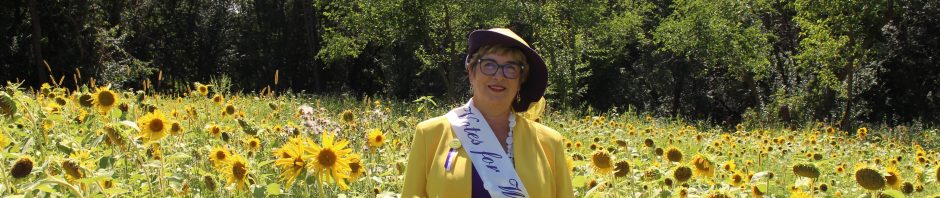
Imagine for a moment it is the year 1850. Surrounded by the wide blue sky and vast open spaces, you hear birds singing, animals roaming, and insects buzzing. The endless prairie grasses wave softly in the wind.
Return to the present. Under that same wide blue sky, a small but prospering town has replaced the prairie where buffalo once grazed and Indians once hunted. The population of Plankinton and the surrounding area today includes descendants of families who emigrated from eastern states or Western Europe starting in the 1880s, as well as those whose families emigrated from Mexico in the not too distant past.
Today’s dedication of the Sweep Van Dyke Hotel and Museum recognizes the past by honoring local history, but keeps it eye focused on the future by opening a new community space.
White settlement of this area started after the U. S. government placed land east of the Missouri River into the public domain, an action that dispossessed local Indian tribes of their land. Anticipating a boom in agriculture when homesteaders, speculators, and town boosters occupied the newly opened land, several railroad companies expanded their routes, laying tracks across Dakota Territory towards the Missouri River.
The first train cars of the Chicago, Milwaukee & St. Paul Railway (the Milwaukee Road) arrived in Plankinton in October of 1880. Two months earlier, General John Lawler, an agent of the railroad, spent $1,000 to acquire 160 acres claimed by Ira Woodin. Lawler then platted the town of Plankinton north and south of the proposed railroad tracks.
That same month, August of 1880, T. J. Ball erected the first commercial building in Plankinton on this very site – a saloon. Evidently not very successful, that building was moved a short month later to the site of today’s Farmers and Merchants State Bank. The re-positioned building then housed the first grocery store and post office, operated by William Anderson, whose descendants still live and farm in this county.
Soon after the first train arrived in October, Theodore C. Granger and his wife Adelia built a structure adjoining the Anderson grocery store and opened the town’s first lodging house. Called the Granger House at first, it later became known as the Plankinton House. The hotelkeeper’s wife received equal billing in an early 1884 advertisement that stated Mr. Granger “is very ably assisted by Mrs. Granger, the estimable landlady of the Plankinton… The traveling trade, pleasure seekers and others will find in the genial host and hostess of the Plankinton, people devoted to their business.”
That first winter for the new pioneers brought deep snow that halted all trains for four months, from January to May, stranding and isolating the Grangers, their boarders, and their few neighbors. Once the snow melted, the land rush began and the area boomed. In addition to carrying stock for town stores, train cars hauled families bringing with them the farm animals, equipment and crop seed, household goods and the supplies that they needed to start new lives. The cars returned carrying local harvests to distant markets. During hard times of drought and depression, those train cars also transported discouraged families back to the places they had left or further west to new opportunities.
When highways replaced railways as the main pathway for transporting people and goods, the trains stopped running. The last passenger train came through in the early 1950s. All railroad traffic ended by 1980. But then, about 2009, the clickety-clack sound of a train on the tracks and the blasts of the warning horn could be heard again as the Dakota Southern line once more carried local harvest to distant markets.
As the newcomers arrived, they needed a temporary place to live, and a number of lodging houses sprang up in Plankinton. A newspaper in 1884 advertised six hotels and two boarding homes! Evidence suggests the Commercial House, now the Sweep Van Dyke Hotel and Museum, opened in the latter part of 1883. Hostelrys advertising before 1890 included the Mansion House, the Iowa House, the Taubman House, the Bounce House, and the Clark House. The Mansion House building, located on the site of the old DeJean/Groeber hardware store, was moved in 1884, and today is the home of Leah Brink, formerly the home of Lorraine Dodd.
By 1906, when Ella Sweep purchased the Commercial House, only the Plankinton House remained as competition. Ella ran the business, now called the Sweep Hotel, with her husband George until he died in 1914. She continued as proprietor until selling out in 1919. Some time after the Sweeps, Josie Furchner managed the hotel while also running a beauty shop in the building. The last to operate the building as a working hostelry, then called the Plankinton Hotel, were Bert and Barbara Van Dyke, who closed the business in the 1970s.
The hotel structure changed little over the years, providing us with the opportunity to imagine ourselves as long ago customers. Constructed with square nails, the restored building boasts wood floors made from virgin timber and beautiful pressed-tin ceilings. Especially noteworthy are the seventeen individual sleeping rooms on the second floor, quite small and mostly intact, with their original numbered doors, each headed with a rare wooden peg swivel window.
In those early years, hotels provided more than just a sleeping room for the night. For example, the first marriage in the county occurred in the parlor of the Plankinton House on Sept. 4, 1882, when Blanche Brady, a teacher from New York, married Irish homesteader Peter McGovern. Many of you will remember their grandson, Lawrence Meoska. Traveling salesmen and medical specialists set up shop in the public areas, advertising their services in local newspapers. Hotels also served as boarding homes for bachelors and teachers or as first homes for newlyweds. Young women, such as Josie Hommel Grambihler and my great-grandmother Anna Kelly Magonegil, found employment, and possibly husbands, while working for those businesses.
Imagine the war years, when some nights the hotel would be filled with young men waiting to board an early train taking them away from home to begin their military service.
Hotels played an important role in bustling new towns and helped ease people’s transition to life on the prairie by welcoming transient visitors, newcomers, and those living alone into a warm and welcoming space. A tribute to Ella Sweep captures that role,
Ella’s cleanliness and exceptionally fine cooking soon attracted many boarders and roomers, also railroad men who soon became their very good friends and advertisers, so that many traveling men also ate there. Many of the townspeople ate Sunday dinner there, also, and news of her fine meals spread.
Today’s hotels, campgrounds, hunting lodges, and dining establishments still play that important role, providing housing and sustenance for those visiting town to participate in weddings, funerals, family reunions, pheasant hunts, and community reunions such as high school alumni and Pheasant Fest.
In 2004, the Plankinton Preservation Society, dedicated to preserving a unique piece of local history, purchased this building and began the hard work of restoring the old Commercial House, later called the Sweep Hotel and then the Plankinton Hotel. Thanks to their efforts, along with the talents of local craftsman, hours of dedication from faithful volunteers, sponsorship from the City of Plankinton, and funding from the Department of Transportation and other grant and private sources, this Railroad Museum and new cultural heritage center honors the past, offers opportunities in the present, and holds promise for the future.
As a museum, this building showcases the early history, tied so closely to the coming of the railroad. As a community center, it provides hospitable space for community events, private events, classes and workshops, weddings, musical concerts, traveling displays, and a number of other purposes. I encourage all of you to volunteer your ideas and especially your time to make the Sweep Van Dyke Hotel Museum a shared and active space for community to happen.
As long as the people in Plankinton believe in the future of their town, this preserved building can serve as a welcoming place for the local community and its visitors. The Sweep Van Dyke Hotel Museum, by representing who we are, where we came from, and who we can become, connects the past to the present and provides hope for the future.
It Happened Right Here: Imagine the Past – Imagine the Future, by Ruth Page Jones, Published in the South Dakota Mail, Plankinton, South Dakota, July 28, 2016.

 RPJ Histories - Ruth Page Jones