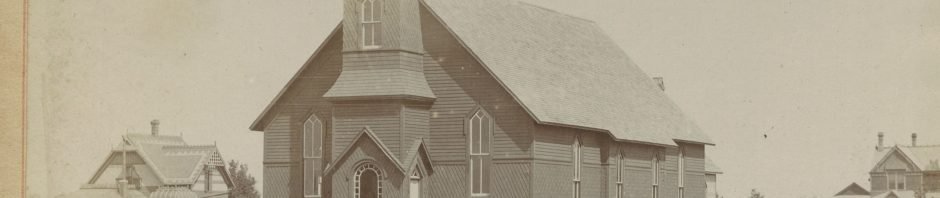
Strong faith in God motivated the Euro-American settlers to establish worship spaces soon after arriving in Dakota Territory. In 1881, two years after the first homesteaders claimed land in Aurora County, a visiting Catholic priest celebrated mass in the dining room of the Plankinton House on Plankinton’s Main Street. Later that year, Protestant members of the community sat on beer kegs in a local saloon to hear the sermon preached by a traveling Congregational minister, a graduate of Yale University. Within a year of those two events, two Catholic and five Protestant congregations had been established, including the Evangelical Lutheran Wessington Congregation, founded by eighteen people from the Norwegian immigrant community in rural Belford Township.
Several more churches arose on the prairie as the area grew during the homesteading era. By 1890, the people of Aurora County were worshiping in one of ten denominations that had built a total of eighteen houses of worship. Membership, defined by the federal census as the number of enrolled communicants, totaled 1,108 people, 43 percent of all adults. (The numbers were reported by the church authorities and, therefore, did not count pious individuals who had not joined a congregation). The Roman Catholics dominated in the county, with a membership of 600 in only two churches, more than half of the total of all church membership. Ranking second in size, the Methodist Episcopal congregation reported 113 members. Membership for most congregations numbered fewer than one hundred, with the smallest group, Protestant Episcopal, numbering only four.
Although the county’s population never reached 8,000, the variety of religious organizations underscores the variation of faith traditions and ethnic origins among the early residents. In the county’s first two decades, from 1880 to 1900, the settlers established at least twenty-one places of worship, including two Jewish settlements, three Catholic parishes, and a number of Protestant congregations. Those Protestant congregations included one Baptist, one Welsh Calvinist, one Congregational, one Presbyterian, one Quaker, two Evangelical, three Methodist, and six Lutheran faith communities. The Lutheran denominations included two General Council churches, two German Synod of Iowa churches, two United Norwegian churches of the Missouri Synod, and one Danish Church of America of the Missouri Synod. Those with deep American roots in the Eastern states or immigrants from England and Wales likely joined the Baptist, Congregational, Presbyterian, Quaker, Evangelical, Calvanist or Methodist congregations, while those whose families had more recently arrived from Scandinavian countries, Europe, or Ireland became members of the Catholic or Lutheran congregations. The families in the Jewish settlements emigrated from Russia.
Although some congregations quickly built churches, other small faith communities attended services in homes or schools on an irregular basis. Preachers, covering an assigned circuit on horseback, covered many miles ministering to communities spread out across the prairie. Sometimes, very small groups organized and found the means to build a house of worship. Starting with just six members, the Methodist Episcopal Church established an official society in Plankinton in 1882, obtained the services of a pastor, and enrolled fifty-nine members that first year. Although the members signed a contract to build a church one year later, the church dedication ceremony did not take place for another two years. Small congregations often received financial assistance from missionary societies and the church authority to build churches and pay the pastors’ salaries. Between 1883 and 1905, the Congregational Building Society of New York City loaned 800 dollars to the Congregationalists in Plankinton, and the Congregational Home Missionary Society granted them a sum of $9,415 (close to $250,000 in today’s money). Started by just six German Lutheran families in 1883, the Evangelical Lutheran St. Paul congregation in Truro Township worshipped monthly in the home of Alois and Louise Matzner. After thirteen years, services were moved to a nearby public school until a church was constructed in 1902. Whether worshiping in homes, schools, or church buildings, religious faith played an important role in the lives of the early residents of Aurora County.
To be continued…
It Happened Right Here: Faith on the Prairie (Part 1), by Ruth Page Jones. Published in the South Dakota Mail, Plankinton, South Dakota, March 30, 2017.
 RPJ Histories - Ruth Page Jones